
| Musicians |
Mats
Gustafsson — fluteophone, soprano & baritone sax |
| Cover and Artwork | 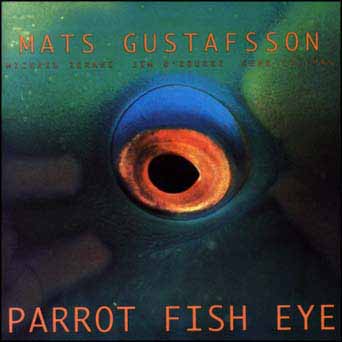 Cover concept: John Corbett & Bruno Johnson |
| Songs |
Mats
Gustafsson with Michael Zerang: Mats
Gustafsson with Gene Coleman, Jim O’Rourke: |
| Recording Info |
Recorded at Sparrow Sound Design, Chicago, IL, October 1994 |
| Liner Notes |
Let
me tell you... I’m trying to capture the fourth dimension of the
new-instant, which is so fleeting it no longer is because it has
already become a new now-instant, which also is no longer. Each
thing has an instant in which it is. I want to take possession of
the thing’s is. Those instants that elapse in the air I breathe:
in fireworks exploding silently in space. I want to possess the
atoms of time.
Within a select group of free improvising musicians, it’s possible to isolate a style that deals in a particular way with the relationship between energy, texture, and time. Of course, if you mention energy it seems natural to immediately think of human powerstations like Cecil Taylor and Peter Brötzmann — those momentum-sustaining heavy-rollers who may turn to violence or volume to achieve full impact. And when the idea of texture is discussed, it tends to conjure the so-called "insect music" of ’70s British improvisers, in which bustling microcosmic worlds were made out of vivid timbre and nutting noise.
But the kind of musician I’m describing actively engages both these spheres, injecting teeny-weeny sounds with thermonuclear power or locating activation energy in the colors and surfaces of musical materials. Somehow the key to this process, this mediation between energy and texture, lies in the musicians’ attentiveness to the manipulation of time, their wish, as Lispector would have it, "to possess the atoms of time" — a transposition of matter and temporality. This is accomplished through a seemingly impossible ability to simultaneously listen for and snatch up the potency inherent in any given moment. Or the next. Or the following. And so on. It can be sudden or it can be gradual. It is nevertheless a seizure, a blink, an openness to the once-and-future now-instant.
The cadre of stylists I’m describing might be best exemplified in the work of German trombonist (cellist and filmmaker) Günter Christmann, British bassist Barry Guy, and German percussionist Paul Lovens, as well as the British duo of vocalist Phil Minton and percussionist Roger Turner. Christmann concentrates on the breakpoint between breath minutiae and metallic blast, rustling aluminum mutes against the bell or suddenly sounding an oboe reed into his mouthpiece. With Guy, there is the explicit wish to find energy’s taproot; he’s capable of turning a placid moment into a detonation, without fuss. Master of the power/texture divide, Lovens takes the klangfarben tradition into a craggy field of unexploded bombs, intensifying the Webernian ethic of texture and timbre with enough TNT to drive the Globe Unity Orchestra or to match wills with Stephan Wittwer’s overdriven guitar.
Minton and Turner’s key — which is in fact the key to all who play this way — is speed. From one millisecond to the next anything might happen: tensions might flare sending sparks and shrapnel flying, or a sudden calm might stop a careening passage in its tracks. For players like this, abruptness and flow aren’t antithetical concepts, but complementary utensils with which to dip into the stream of life. In all these cases, to make such strategy work the player must be an infinitely skilled listener and a bold opportunity seeker. She or he must hook into what the other musicians are doing — even if that means laying out altogether for some time — but must also be eager to initiate.
Such is the tradition in which we find 30-year-old Swedish saxophonist Mats Gustafsson. Born in the severe frigidity of Lappland, Gustafsson has been a core figure in the active Stockholm scene since he settled there years ago. His own groups include Gush, with keyboardist Sten Sandell and percussionist Raymond Strid; Two Slices of Electric/Acoustic Car, with guitarist Christian Munthe; the AALY Quartet with pianist Per Henrik Wallin; and a trio with Lovens and fellow percussionist Paul Lytton. He’s also a member of Georg Gräwe’s new quintet, plays in various groups with Barry Guy, is a frequent member of Günter Christmann’s ever-changing project VARI0, and likes to collaborate with dance, theater, and poetry.
Like the aforementioned players, Gustafsson uses the now-instant as a fulcrum between the materials and energies of his music. And speed is of his essence. Whether he is playing his own mercurial "fluteophone" (a mutant horn he created by shoving an alto sax mouthpiece into a flute), or down at the other end of the sound spectrum on the notoriously unwieldy baritone saxophone (which only a handful of free improvisers have successfully used), Gustafsson has an uncanny ability to precipitate impulsive interaction at lightning pace. Where many improvisers are comfortable in stable dynamic zones — if it’s loud and boisterous, it stays loud and boisterous; if it’s soft and gentle, it remains so — he often finds a way to move from as-pianissimo-as-possible to triple-forte and back in the bat of an eyelash.
Recognized by elder improvisers for his prodigious group skills, Gustafsson has also developed a singular saxophone sound. No question that he is part of the post-Parker (Evan Parker, that is) generation, as evidenced in his combination of various extended techniques — multiphonics, circular breathing, slap tongue — the extensive exploration of which actually dates back to trick vaudevillian saxophonists from the 1910s, such as Rudy Wiedoeft. But Gustafsson’s got a range of tricks all his own up his sleeve, from multifarious vocalizations (I like his lion-like growl best) to the heartstopping, brain-bending outerspace ant sounds he produces on fluteophone. On baritone, he has awesome control, making resounding low pops or sticking a tin can all the way down the long bell to the U-bend to serve as a buzzy mute. If you listen hard, you can hear a trace of his inspiration Serge Chaloff in Gustafsson’s full exploitation of the big horn.
While working on Parrot Fish Eye in October, 1994, during a week-long stay in Chicago, the word that kept popping up in Mats’ speech was "focus." That still rather vague term may come closest to describing the qualitative difference between a decent improvised session and one to write home about. The feeling was that, though there was only a single concert performance with the trio with Gene Coleman and Jim O’Rourke (on-the-job rehearsal), the one-day recording produced a really remarkable level of focus. Especially delightful was the way that Mats and Michael Zerang, who had never met, shook hands, tuned up, and took off. Indeed, it was the sort of scary compatibility one doesn’t dare hope for, especially in a first encounter.
Zerang is a mainstay on several Chicago scenes. He plays traps with the Vandermark Quartet and has a duo with percussionist Hamid Drake in which hand percussion is emphasized (especially Mesopotamian frame drums). With his free improvising trio Liof Munimula (which includes shortwave radio wizard Don Meckley and multi-instrumentalist Dan Scanlan), Zerang deploys the same sort of spread out multiple percussion setup he used with Gustafsson. The pair instantly connected, much to even their own surprise. Listen to the way they construct things together, punctuating and sometimes finishing one another’s statements. It’s as if they become a single working entity, a strange sort of clock: interlocking gears ticking, alarm bells ringing, a sweep second hand marking swift time.
The trios are of a very different nature — somewhat more deliberate and conceptual sounding — though they too relate back to quick-thinking energy distribution. Jim O’Rourke is a highly prolific improviser and composer, well-known internationally for his guitarwork and his part in the experimental rock ensembles Gastr del Sol and brise glace. He’s also a super composer, who uses pen and paper as well as tape and razor to realize his compositions. Long term mover and shaker on the Windy City’s independent contemporary classical scene and leader and prime composer for Ensemble Noamnesia, Gene Coleman has also been steadily developing his approach to the bass clarinet and its hidden harmonic mysteries. He and Mats make a versatile reed team, especially in tandem with O’Rourke’s resplendent acoustic guitar and extreme accordion.
Focus. As a verb or noun? Noun: center, reference, concentration, attention or attraction. Verb: to make something clear. The clarity and centering represented in Lispector’s fleeting meditation on time are crystalline focal points. So is the music on Parrot Fish Eye. A flash of instants provides the constantly shifting point-of-reference and a place for concentration and attention. Lens music. Song of the it. Focus.
Ah,
this flash of instants never ends. Will my song of the it never
end? I’m going to end it deliberately, with a voluntary act. But
is continues on in constant improvisation, creating always and forever
the present which is the future. This improvisation is.
-
John Corbett |
| Reviews | ***(*) (3 1/2 stars)
Parrot Fish Eye, recorded on an early visit to Chicago, is perhaps the most fun of all his records and might be the easiest place to start with Gustafsson. There’s an almost zoological feel to eight duos with percussionist Zerang, whistles, chitterings and unidentified sounds creating an aura of animal-house nuttiness. Five trios with Coleman and O’Rourke are more stealthy in the way they unfold and, if Gustafsson is comparatively reserved here, he and Coleman make an interesting “front line”, if that term’s appropriate. — Richard Cook & Brian Morton, The Penguin Guide to Jazz on CD, fifth edition Heaven knows what possessed Laplander Mats Gustafsson to force an alto saxophone mouthpiece and a flute together, but it’s a shotgun marriage that has borne remarkable fruit. Parrot Fish Eye quivers with the squawk of his invention, his monster, the fluteophone: through it he delivers a piercing stream of squeaks and percussive tonguework with devastating rapidity. At volume, the high tones really hurt the ears. More conventionally, he also plays soprano and baritone saxes. Gustafsson is active in various Stockholm groups and counts German pianist Georg Gräwe and bassist Barry Guy among his collaborators. The latter connection seems particularly appropriate, as he shares some of Guy’s bursting intensity and speed, not to mention building on Evan Parker’s advances in extended technique. Parrot Fish Eye, recorded last year in Chicago, has Gustafsson in action in two distinct settings: a duo with percussionist Michael Zerang, and a trio with bass clarinetist Gene Coleman and Jim O’Rourke, who plays guitar, percussion and accordion. Of the two, the duo material is perhaps the more exciting, with an uncluttered field allowing Gustafsson to work more freely. Daring, tumultuous and virtuosic, when Parrot Fish Eye says "play me", you do it. - Will
Montgomery |